

Insights
Speaking LBQ Realities from Nigeria at the UN Side Event in Geneva
Region(s)
Type
Commentary
Author(s)
Publish Date
June 30, 2026
Share
Last week, I joined a delegation of lesbian, bisexual, and queer (LBQ) activists from around the world in Geneva for the 62nd Session of the UN Human Rights Council, where the Independent Expert on protection against violence and discrimination based on sexual orientation and gender identity presented the first-ever UN report on violence against LBQ women. Participating in the UN side event organized by Outright International, ILGA World and RFSL felt like one of those rare moments where our voices as grassroots activists actually made it into the room.
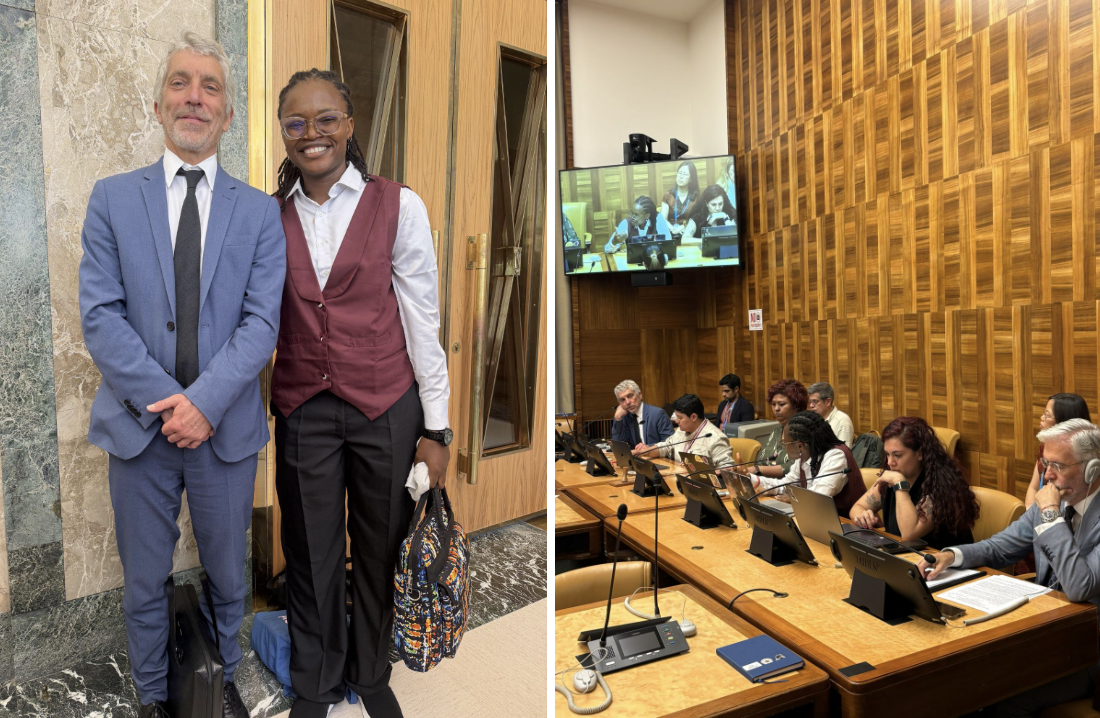
Caption: Deborah with the IE on SOGI Graime Reid; Photo 2: Deborah speaking at the LBQ+ advocacy week in the UN side event.
Standing alongside fellow activists, I wasn’t just there to observe. As a representative of the Women in Innovation and Tech Initiative (WITI), where we work to empower LBQ women through digital literacy and climate justice initiatives that strengthen their economic independence, I was there to speak to diplomats, UN agency representatives, and other activists as part of a panel discussion, bringing the realities of LBQ women from Nigeria and the broader African context into a space that doesn’t always hear us clearly.
The room carried a certain energy. It wasn’t just another meeting. There was a shared understanding that this report by the independent expert, Graeme Reid, was significant and that the way we spoke about it mattered.
I spoke about how economic dependence continues to trap LBQ women in situations they would otherwise leave. As the report highlights in Paragraph 13, LBQ women’s access to housing, land, and economic security is often conditioned on or mediated through relationships with men, undermining both their autonomy and their ability to live safely and openly. When there is no independent income, no safe housing, and limited access to support systems, forced or coerced marriage frequently becomes the only visible path to survival. The report in Paragraph 17 also finds that in many contexts, marriage to a man is often the only way for LBQ women to escape family surveillance and control. These are the daily realities we hear from LBQ women who walk into our spaces—women seeking a way out, or, at the very least, a way to survive.
I also touched on how climate change is worsening women's economic dependence. When floods destroy homes and small businesses, women who were already struggling lose what little they had. For some LBQ women, this pushes them deeper into vulnerability, sometimes leaving them with no choice but to accept marriages they never wanted. We can’t keep separating climate impacts from the violence and control women face.
A further concern I raised was how technology is becoming another tool used against us. Blackmail, leaked images, online threats — these are becoming more common, yet many LBQ women don’t have the resources or support to deal with them safely. In places where digital safety is limited, this kind of violence often goes unreported, undocumented, and unaddressed.
And then there are the laws that criminalize same-sex conduct and queer rights advocacy. I shared what happened recently in Nigeria, where police raided a private gathering and arrested ten women perceived to be LBQ. They were held for days, starved, and extorted. Not because they committed a crime, but because the law allows this kind of violence. This is the environment we’re working in. It makes it incredibly hard for LBQ women to speak up when they’re abused by family or partners because the fear of being exposed, arrested, or threatened is always there.
Being in that room in Geneva reminded me why multilateral spaces like this matter. They ensure the experiences of LBQ women from the Global South are centered in global conversations. We brought our truths, our frustrations, and our hopes into that room. Change might take time, but moments like this matter—because they show that we’re here, and we’re not going anywhere.
*Deborah Iroegbu is a guest author.
Take Action
When you support our research, you support a growing global movement and celebrate LGBTIQ lives everywhere.
Donate Now