
Insights
When “Gender” Becomes a Dangerous Word
Region(s)
TOPIC(s)
Type
Commentary
Author(s)
Publish Date
March 24, 2026
Share
The expanded Global Gag Rule and the fight over language at CSW are two fronts of the same war. Here’s what’s actually happening and why it matters.
Shift at the United Nations We Cannot Ignore
After two weeks, one of the largest annual meetings at the United Nations, the Commission on the Status of Women (CSW), concluded in a way that signals a broader shift in global politics.
For the first time ever, this 70th Commission’s agreed conclusions were not adopted by consensus. They were forced to a vote. Every country on the Commission cast a ballot. Only one voted against: the United States.
That moment alone marked a departure from decades of diplomatic practice. But it did not stop there.
On the final day of the session, the United States called for another vote. This time, the U.S. delegation tried to pass a standalone resolution entitled “Protection of women and girls through appropriate terminology,” which would have limited the meaning of “gender” to “men and women.” The resolution claimed to draw from the historic 1995 Fourth Conference of Women in Beijing - but what the U.S. got wrong was that the Beijing Declaration and Platform for Action, which has been the inspiration for 30 years of work toward gender equality, never defined gender in an exclusionary way.
The language battles at CSW have always been intense. Whether a document says “all women and girls” or simply “women and girls” can determine whether trans women are understood to be included. Whether the text references “gender-based violence” or only “violence against women” determines whether the framing acknowledges violence based on sexual orientation, gender identity, or sex characteristics, not just sex.
This is often described as a debate about language. It is not.
These words determine who is recognized, who is protected, and who is excluded. Whether a text includes or omits a single term can ultimately shape funding decisions, influence national laws, and affect whether people can safely access services. Language at the United Nations is not symbolic. It has real consequences. What is new is not that these debates are happening, but how openly and aggressively they are now being used to roll back existing understandings.
Centering People, Not Language
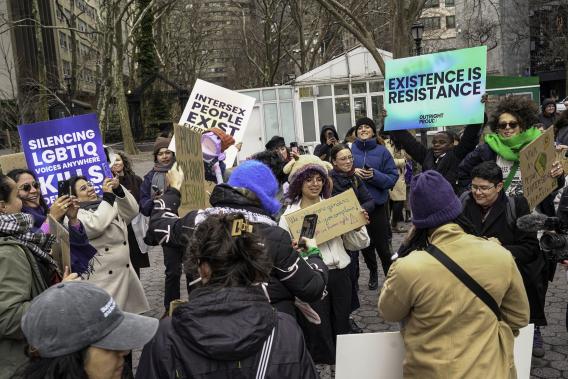
In the midst of these negotiations, Outright organized an event inside UN headquarters called “We are still here.” The intention was simple: to center people, not language. We heard from human rights defenders from around the world, including Natalino, a gay man from Timor-Leste, who said:
Quote from Natalino
“When I hear people say we must protect the children, I ask: which children? Because I was a child, and no one protected me. I was bullied, I was afraid, and I learned to hide who I was just to survive. Today, millions of LGBTI children still live this reality. If protection does not include all children, then it is not protection. It is exclusion.”
And Connex, a trans man from Malawi, described a horrific assault he was subjected to in his home country and finished by saying:
“If you erase us from language, you erase us from protection.”
This is what is at stake in the debates unfolding at the United Nations.
A Changing Environment
The events at the United Nations are not happening in isolation. They are part of a broader shift in the global environment.The rules of engagement are changing. Issues that were once considered settled are being reopened. And narratives framed around “protection” are being used to justify exclusion.
What the Expanded Global Gag Rule Actually Does
These shifts are already being translated into policy, with immediate consequences.
The expansion of the Global Gag Rule by the United States in 2026 represents a significant escalation. Previous versions, first introduced in 1984, restricted global health funding for organizations that provide or advocate for abortion services. The policy has been enacted and revoked by successive administrations for decades. This version is fundamentally different.
Three changes matter most.
First, the policy now applies to all State Department non-military foreign assistance, not just health programs. This includes humanitarian assistance, education, governance, agriculture, nutrition, refugee support, water, and sanitation. More than $40 billion in foreign assistance is now subject to these conditions.
Second, it applies, for the first time, to U.S.-based organizations, to the United Nations itself, and to other multilateral institutions. Previous versions only affected foreign organizations.
Third, the restrictions go far beyond abortion. The new policy, officially titled “Promoting Human Flourishing in Foreign Assistance,” includes a rule called “Combating Gender Ideology in Foreign Assistance.” This prohibits any speech or programming that recognizes transgender identities, supports legal gender recognition, provides gender-affirming care, or advances what the administration characterizes as “gender ideology.” A separate rule also restricts diversity, equity, and inclusion work.
They expand the policy from targeting specific services to reshaping the conditions under which global development and human rights work can operate.
The implications are already visible. Organizations are reassessing programs, partnerships, and funding streams. One of the most immediate risks is over-compliance, where vague or broadly framed restrictions lead organizations to scale back far beyond what is required.The result is a chilling effect that leaves LGBTIQ people excluded and more vulnerable.
We Are Still Here
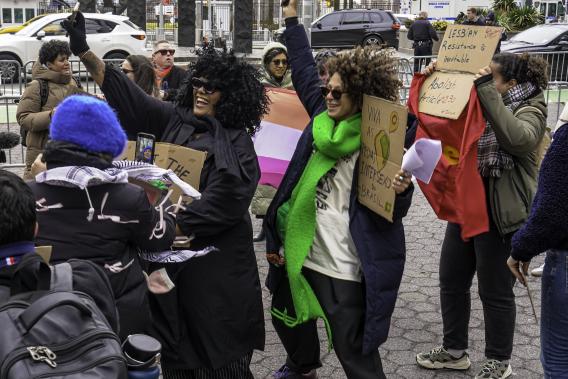
I felt a heightened sense of urgency at this year’s Commission. We secured critical meetings with states and UN agencies. For the first time, we secured a meeting with the Secretary-General. It is important to maintain visibility and make sure that the decision-makers hear directly from us. This is how I opened my remarks:
Quote from Maria Sjödin
"This moment is extremely critical for both the United Nations and for LGBTIQ people globally. Our communities are facing sustained political pressure, and LGBTIQ people are being instrumentalized as a political “issue” - with claims that our existence is an ideology, including within multilateral spaces."
It matters that I could say that on behalf of a delegation that represented LGBTIQ human rights defenders from all regions of the world. Outright also co-hosted the first-ever side-event on intersex issues inside UN Headquarters. One of the speakers, from UN Women, stated that intersex issues are “central to the unfinished gender equality project, not a niche issue.”
During UN convenings, our New York office becomes a hub for activists from around the world. Strategies are shared, meetings with governments and UN officials take place, and urgent concerns are brought directly into global decision-making spaces. In between, it becomes something else as well, a place to pause, regroup, and be among peers who understand the stakes. When someone has traveled thousands of miles (or kilometers!) to be here, that matters. In an environment where access is increasingly contested, spaces like this are not incidental. They are essential.
Wrapping up this year’s CSW, I am filled with determination. And in spite of all the challenges, I leave feeling a little more hopeful.
We are still here.
And we will continue to show up where these decisions are being made, alongside the activists and communities most affected by them.
Take Action
When you support our research, you support a growing global movement and celebrate LGBTIQ lives everywhere.
Donate Now