

Report
Advocacy for Comprehensive Nondiscrimination Legislation in Asia
Region(s)
Author(s)
Publish Date
March 3, 2026
Share
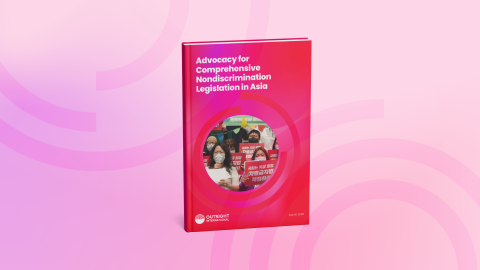
No country in Asia has a comprehensive law protecting LGBTIQ people from discrimination. But across the continent, activists are building the case for change.
From courtrooms to coalition tables, LGBTIQ activists across Asia are challenging laws that leave them unprotected—or actively targeted. In a region where protections based on sexual orientation, gender identity, gender expression, and sex characteristics remain fragmented at best, movements are forging new paths toward equality.
This report maps the advocacy landscape for comprehensive nondiscrimination legislation in 13 Asian jurisdictions: Bhutan, Hong Kong, India, Indonesia, Japan, Malaysia, Mongolia, Nepal, the Philippines, South Korea, Sri Lanka, Taiwan, and Vietnam. While a small number of countries have piecemeal protections in limited areas, none has adopted a comprehensive nondiscrimination law that explicitly protects LGBTIQ people from discrimination in access to goods, services, housing, education, employment, and health care.
Drawing on a private convening at the ILGA Asia Conference in Kathmandu, an online focus group, and interviews with 20 frontline activists conducted between October and December 2025, the report examines the strategies, wins, and obstacles shaping the fight for inclusive legal reform—and documents how movements are adapting to political realities ranging from legislative stagnation to outright criminalization.
Key Findings: Innovation Amid Resistance
Legislative Stagnation Persists
Across the region, governments lack the political will to advance nondiscrimination laws despite growing public support and civil society pressure. South Korea’s comprehensive antidiscrimination bill, first proposed in 2007, has never made it past the subcommittee stage in nearly two decades of advocacy. Japan’s 2023 law on “public understanding” of sexual orientation and gender identity was adopted only after enforceable nondiscrimination provisions were stripped from the text. In the Philippines, the SOGIESC Equality Act, which aims to prohibit discrimination against LGBTQ people, has been blocked for over 26 years, despite passing the House of Representatives twice, and a Comprehensive Anti-Discrimination Bill is also confronting barriers. In Taiwan, the government-backed Antidiscrimination Act remains under review and has not been formally introduced to the Legislative Yuan despite commitments in the 2022 National Human Rights Action Plan.
Piecemeal Reforms Provide Limited Relief
Where comprehensive laws remain out of reach, sectoral reforms have expanded some protections. Mongolia’s 2022 Labour Code prohibits employment discrimination based on sexual orientation, gender identity, and gender expression—a rare national statutory protection in the region. Taiwan’s Gender Equity Education Act and Gender Equality in Employment Act incorporate sexual orientation and gender identity–based inclusion in education and labor contexts. Japan’s ministry-level regulations recognize outing and harassment based on sexual orientation and gender identity as prohibited workplace conduct. But these piecemeal wins leave persistent gaps: none of these protections extend to basic social needs like housing or health care, and enforcement is often inconsistent.
Intersex Protections Are Absent Everywhere
No jurisdiction, among the 13 included in the report, references sex characteristics in existing nondiscrimination laws or prohibits medically unnecessary interventions on intersex children. This is the region’s most consistent—and most telling—gap. While some intersex-led organizations are conducting awareness-raising and advocacy, including Campaign for Change in Nepal and Beyond Boundaries in Hong Kong, intersex communities remain largely invisible in legislative discussions. Advocates’ proposals—like KAIN’s draft bill in Indonesia—are notable exceptions: they explicitly include sex characteristics as a protected ground.
Coalition-Building Is Reshaping Advocacy
Multisectoral coalitions have become a defining strategy across the region. In the Philippines, the Stop the Discrimination Coalition unites LGBTIQ groups with indigenous peoples, disability advocates, labor unions, and other marginalized communities around a Comprehensive Anti-Discrimination Bill. In South Korea, a coalition of more than 100 organizations—spanning feminist, disability, labor, youth, and LGBTIQ groups—frames nondiscrimination as essential to democratic governance and social justice. In Indonesia, the KAIN coalition of around 50 groups representing diverse marginalized communities is lobbying for a national comprehensive antidiscrimination law.
Criminalization Remains a Barrier
In several jurisdictions, criminalization of same-sex intimacy and gender-diverse expression actively blocks the path to nondiscrimination protections. Malaysia enforces federal colonial-era sodomy provisions alongside expansive state Shariah enactments—in 2026, a Pride-themed community event was cancelled following harassment and security threats. Sri Lanka retains Sections 365 and 365A of the Penal Code, colonial-era provisions criminalizing same-sex conduct. Indonesia’s new Penal Code, which went into effect in January 2026, allows prosecution for extramarital sex and cohabitation, exposing same-sex couples to legal risk. South Korea’s military criminalizes same-sex intimacy among service members.
Courts Are Leading Where Legislators Won’t
Judicial leadership has been a primary driver of change, particularly in South Asia. India’s Supreme Court has interpreted constitutional equality guarantees to include both sexual orientation and gender identity, striking down the criminalization of consensual same-sex intimacy in 2018 and recognizing transgender persons as a “third gender” with constitutional protection. Nepal’s Supreme Court has issued landmark decisions spanning nearly two decades—from its 2007 ruling directing the government to end discrimination, to its 2023 interim order enabling same-sex marriage registration, to its 2024 judgment recognizing legal gender without medical requirements. Taiwan’s Constitutional Court established that sexual orientation is protected under equality guarantees, paving the way for the jurisdiction to become the first in Asia to recognize same-sex marriages in 2019.
Country Findings at a Glance
The report groups the 13 jurisdictions into five categories reflecting where each movement stands in its advocacy trajectory:
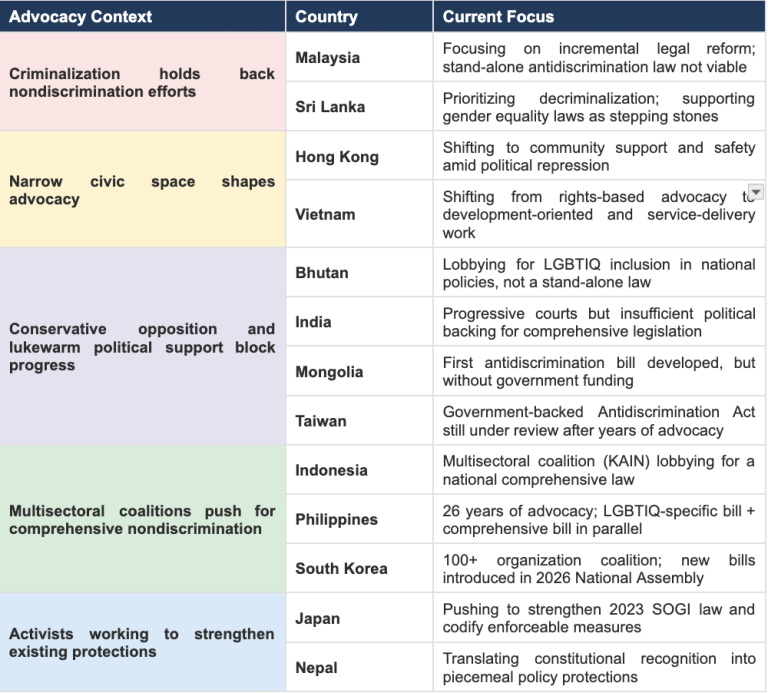
Country Snapshots
Each case study examines the situation of LGBTIQ people, existing legal protections, advocacy strategies, challenges, and pathways forward. Here is what the report found in each jurisdiction:
Bhutan:
After decriminalizing same-sex relations in 2021, activists are lobbying for LGBTIQ inclusion in national gender equality, health, employment, and education policies. A 2024 survey found that 81 percent of respondents believed discrimination continues to affect LGBTQ people. Advocates are leveraging the Gross National Happiness framework to counter narratives that inclusion is a foreign imposition.
Hong Kong:
Activists have sought to include sexual orientation in antidiscrimination laws since the late 1990s. Despite major court victories on spousal benefits and immigration, the Legislative Council’s 2025 rejection of a partnership bill marked a significant setback. Escalating political repression under the National Security Law is pushing advocates to prioritize community support and safety.
India:
Progressive Supreme Court jurisprudence has expanded constitutional protections, but India still lacks comprehensive antidiscrimination legislation. In 2025, a new coalition launched “Queering the Law: Beyond Supriyo,” a series of policy briefs advocating for recognition of queer relationships, prohibitions on conversion practices and non-consensual intersex surgeries, and a comprehensive antidiscrimination law. The ruling party opposes same-sex civil unions and has not moved to prohibit discrimination by law.
Indonesia:
Amid criminalization and social hostility, the KAIN coalition of around 50 groups is pushing for a national comprehensive antidiscrimination law. Two cities in Eastern Indonesia—Ambon and Palu—have already passed local antidiscrimination policies covering gender identity and gender expression. Activists are framing nondiscrimination as a basic principle of citizenship, not a special request from a specific group.
Japan:
Following the adoption of the 2023 SOGI Understanding Promotion Act, activists are pushing for a responsive basic plan and an enforceable antidiscrimination law. A 2024 survey found that 44 percent of respondents had experienced workplace discrimination based on sexual orientation, while 90 percent of LGBTQ students experienced harassment or difficulties at school. The February 2026 election gave conservative Prime Minister Takaichi a broad mandate, raising concerns about progress.
Malaysia:
Criminalization under both federal and state Shariah law makes a stand-alone antidiscrimination law politically unviable. Advocacy focuses on incremental reform through engagement in Penal Code reviews, strategic litigation, survivor-centered services, and coalition-building with women’s rights organizations. Digital safety and protections against doxxing have emerged as pragmatic entry points.
Mongolia:
In July 2025, ruling party legislators introduced the country’s first antidiscrimination bill, listing sexual orientation and gender identity among 17 protected characteristics. However, the government has not allocated funding for the drafting process, leaving the bill technically weak. Activists are prioritizing research, coalition-building, and securing international pro bono legal expertise.
Nepal:
Nepal’s 2015 Constitution is the only one in Asia that explicitly recognizes sexual and gender diversity. With no pending antidiscrimination bill in parliament, activists are working to translate constitutional recognition into enforceable policy—from amending the Civil Code for marriage equality to securing inclusive social security provisions. Anti-gender actors are gaining ground, with some politicians vowing to stop marriage equality.
Philippines:
Activists have lobbied for the SOGIESC Equality Act for 26 years—the bill passed the House twice but has never cleared the Senate. In parallel, the Stop the Discrimination Coalition is pushing a comprehensive bill covering LGBTIQ people alongside indigenous peoples, persons with disabilities, and other marginalized groups. A 2025 study found LGBTQ Filipinos are twice as likely as their non-LGBTQ counterparts to be underemployed and three times as likely to be in vulnerable employment.
South Korea:
A coalition of more than 100 organizations has been campaigning for a comprehensive antidiscrimination law since 2007. New bills were introduced in the National Assembly in January and February 2026, but face resistance from organized, conservative evangelical groups. The current National Human Rights Commission chair has blocked internal discussions on LGBTIQ protections and refused to attend the Seoul Queer Culture Festival in 2025, the first time in eight years that a human rights commission chair has not participated.
Sri Lanka:
Activists are prioritizing decriminalization of same-sex intimacy, buoyed by a Supreme Court ruling that affirmed decriminalization “only furthers human dignity.” The Gender Equality Bill, which would advance equality regardless of sex and gender identity, was ruled unconstitutional by a three-judge bench in 2024. A united interreligious opposition from Christian, Muslim, Buddhist, and Hindu leaders is seeking to block equality reforms.
Taiwan:
Despite being Asia’s leader on marriage equality since 2019, Taiwan still lacks a comprehensive antidiscrimination law. The government’s draft Antidiscrimination Act covers sexual orientation, gender identity, and gender expression, but remains under review and has not been introduced to the Legislative Yuan. Anti-trans mobilization is gaining influence, spreading misinformation during public consultations and framing gender identity protections as threats to women and children.
Vietnam:
LGBTIQ activists are strategically shifting from rights-based advocacy to development-oriented and service-delivery work in response to government restrictions on civil society. One in 10 LGBTIQ respondents to a national survey in 2023 reported severe discrimination in the past year, with transgender respondents consistently reporting the highest levels. Advocates frame inclusion through values of happiness, family, and social harmony rather than human rights language.
Voices from the Ground
The report centers the expertise and strategies of frontline activists. Their insights reveal not just the barriers they face, but the creativity and resilience driving their movements forward.
Quote from Tashi Tsheten
“The long-term goal is to harmonize and make existing laws and policies inclusive across sectors, instead of lobbying for separate, standalone laws that could unintentionally place the community under heightened scrutiny.”
Quote from Ging Cristobal
“This is an opportunity to build broader coalitions. The question is: will groups grab it?”
Quote from Riska Carolina
“Activists in Indonesia are now two or three steps ahead compared to 2016, during the crackdown on civil society. They have a tighter community now.”
What’s Inside the Report?
- International human rights framework: How UN treaties, the Yogyakarta Principles, and the Sustainable Development Goals create state obligations for nondiscrimination based on sexual orientation, gender identity, gender expression, and sex characteristics.
- Comparative global approaches: Models for nondiscrimination legislation worldwide—from comprehensive equality statutes in Spain to judicial pathways in Colombia and Nepal, sector-specific reforms, and criminal law approaches.
- Regional key findings: Recent wins, regression, and the forces shaping the advocacy landscape across Asia, including the role of courts, coalition-building, criminalization, and anti-gender movements.
- 13 in-depth case studies: Country-specific analysis of the situation of LGBTIQ people, existing protections, advocacy strategies, challenges, and ways forward for each jurisdiction.
- Voices from the ground: Insights from 20 frontline activists across 13 countries on what’s working, what’s stalled, and what’s needed to advance comprehensive nondiscrimination protections.
Read the Full Report
Access the complete analysis, including all 13 case studies, comparative frameworks, and activist perspectives, to understand where nondiscrimination advocacy stands in Asia—and what it will take to move forward.
Support the Fight for LGBTIQ Equality
The activists featured in this report work in challenging environments and with limited resources. Their movements are sustained not only by landmark decisions or legislative debates, but by the everyday work of organizing, coalition-building, and community care.
More than $125 million has been stripped from the global LGBTIQ movement through funding cuts. The frontline organizations fighting for nondiscrimination protections across Asia need support now more than ever.
Frequently Asked Questions (FAQ).
What is this report about?
This report maps the advocacy landscape for comprehensive nondiscrimination legislation protecting LGBTIQ people in 13 Asian jurisdictions: Bhutan, Hong Kong, India, Indonesia, Japan, Malaysia, Mongolia, Nepal, the Philippines, South Korea, Sri Lanka, Taiwan, and Vietnam. It examines the strategies activists are using, the legal protections that exist, the barriers they face, and the pathways forward for inclusive reform.
Does any country in Asia have a comprehensive nondiscrimination law protecting LGBTIQ people?
No. While a small number of countries—including Israel, Mongolia, Nepal, the Philippines, Taiwan, and Thailand—have piecemeal protections in limited areas, no country in Asia has adopted a comprehensive nondiscrimination law that explicitly protects LGBTIQ people from discrimination in access to goods, services, housing, education, employment, and health care.
What methodology was used?
The report draws on insights from a private meeting organized by Outright during the ILGA Asia Conference 2025 in Kathmandu, Nepal; an online focus group discussion; and semi-structured interviews with 20 activists representing all 13 countries. Information was supplemented through desk research, including media reports, government publications, human rights documentation, and United Nations submissions.
What are the main barriers to nondiscrimination legislation in the region?
The report identifies several persistent barriers: criminalization of same-sex intimacy and gender-diverse expression in several countries; legislative stagnation driven by insufficient political will; organized opposition from conservative and anti-gender movements; shrinking or narrow civic space that constrains advocacy; and the total absence of legal protections based on sex characteristics in all 13 jurisdictions studied.
Are there any recent wins for LGBTIQ people’s rights in Asia?
Yes. Recent progress includes landmark judicial decisions in India, Nepal, and Taiwan expanding protections; Mongolia’s 2022 Labour Code explicitly prohibiting employment discrimination based on sexual orientation, gender identity, and gender expression; marriage equality in Taiwan in 2019; Nepal’s Supreme Court enabling same-sex marriage registration in 2023; and the growth of multisectoral advocacy coalitions in countries such as Indonesia, the Philippines, and South Korea.
What does the report recommend?
Each of the 13 case studies concludes with context-specific “ways forward” developed in consultation with activists. Common strategies include strengthening cross-movement coalitions; deepening engagement with legislators; leveraging international human rights mechanisms; advancing incremental reforms while keeping comprehensive legislation as the goal; and centering culturally relevant, values-based messaging that resonates in each national context.
How can I use this report?
Activists can use the country analyses and strategies to inform their own advocacy. Policymakers can draw on the comparative frameworks to design inclusive legislation. Journalists can use the findings to inform reporting on LGBTIQ-inclusive legal protections in Asia. Donors and international organizations can use the report to understand where support is most needed and what approaches are proving effective.
Read More
Lesbian, Bisexual, and Queer Women Online: An Overview of Emerging Security Threats
Gender-Based Violence ,
Asia ,
A Year in Attacks on Trans, Intersex, and Nonbinary People’s Human Rights
Anti-LGBTIQ Backlash ,
Global ,
Explore News and Commentaries
We share news, cultural media and advocacy of partners, activists and experts through the lens of LGBTIQ people working on international human rights.
Read Our Insights