

Report
Context and Culture of Online Gender-Based Violence Against LBQ People in Bangladesh
Region(s)
TOPIC(s)
Author(s)
Publish Date
February 20, 2026
Share
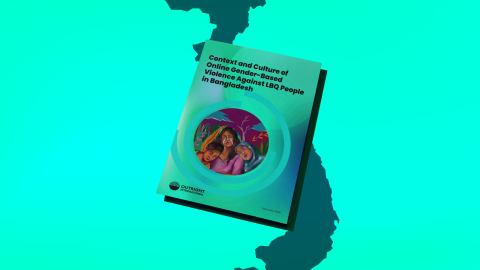
A study documenting how lesbian, bisexual, and qu(LBQ) people in Bangladesh experience online gender-based violence (GBV) in a context of criminalization, patriarchal norms, and rising digital threats.
About This Report
This report on Bangladesh is part of a series that explores online gender-based violence against an often-ignored group of victims—lesbian, bisexual, and queer (LBQ) women and people. Attacks on LBQ people online are shaped by both misogyny and homophobia and take distinct forms, particularly in countries that criminalize consensual same-sex intimacy, which are currently missing from the literature on technology-facilitated, gender-based violence.
Beginning in 2023, Outright International undertook a study across five Asian countries—Bangladesh, Indonesia, Malaysia, the Philippines, and Vietnam—surveying and interviewing close to 500 respondents for a first-of-its-kind look at queer women’s experiences of gender-based violence online.This report shares findings from Bangladesh, based on 104 survey responses and 10 in-depth key informant interviews, and offers recommendations to policymakers and other stakeholders.
A Note on “LBQ” in Bangladesh
LBQ communities are often marked by fluidity and openness. In Bangladesh, the category “LBQ” is often understood to embrace trans men and nonbinary persons, with 48 percent of all survey respondents identifying as trans men at the time of data collection. For this report, “LBQ people” therefore covers cis and trans LBQ women; LBQ persons who are nonbinary, genderfluid, agender, or genderqueer; and some trans men.
Context: Rights of LGBTIQ People and Online Spaces in Bangladesh
Bangladesh is one of the largest Muslim nations in the world, and the designation of Islam as the official state religion has a significant impact on both state policy and the lives of religious and other minorities. A combination of legal discrimination and social prejudice relegates LGBTIQ people to second-class citizenship. Section 377 of the Penal Code, a relic of British colonial rule enacted in 1860, criminalizes same-sex conduct between men. While the law is rarely enforced, its existence creates an environment where all LGBTIQ people are marginalized and denied equal rights.
While the constitution prohibits discrimination based on religion, race, caste, sex, or place of birth and guarantees equal protection of the law, LGBTIQ people do not enjoy specific legal recognition and protection. There are no laws in Bangladesh that forbid discrimination based on sexual orientation or gender identity. Same-sex civil unions or marriages are not legally recognized.
LBQ people face compounded discrimination based on both their gender and sexual orientation. In a country where patriarchal norms prevail, LBQ people are subjected to violence as women, on top of violence based on their sexual orientation. According to a 2024 national survey, 76 percent of women have experienced at least one form of intimate partner violence in their lifetime. LBQ people “are pressured to enter heterosexual marriages” and “are less likely than men to have social and economic independence.”
LGBTIQ organizing took a sharp turn in April 2016, when Islamist extremists killed Roopbaan magazine’s founders, Xulhaz Mannan and Mahbub Rabbi Tonoy, in a hate crime. The murders led to growing fear about safety, with public activities discontinued and LGBTIQ activists forced underground. Recent political events have further impacted LGBTIQ communities, with anti-LGBTIQ violence reportedly increasing in 2025.
Digital Bangladesh
By January 2025, there were 77.7 million internet users, including 60 million social media users (34 percent of the country’s population). Facebook is the dominant platform with over 60 million users, though men account for 63.2 percent of all users. According to a 2022 ActionAid survey, nearly 64 percent of female participants had experienced online violence in the past 12 months. As our research found, this problem may be even more pronounced for LBQ people as a result of compounding forms of discrimination.
Who Participated in This Study
The study collected 104 survey responses and conducted 10 in-depth interviews with self-identified LBQ people using both online and offline data collection approaches. Respondents were invited through a network of queer organizations in Bangladesh.
Sociodemographic Profile
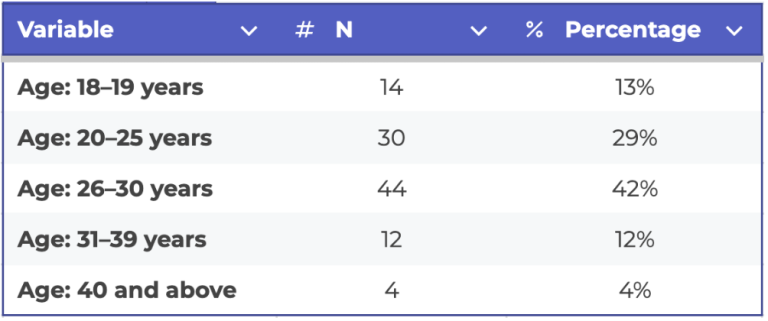
Additional demographic highlights:
- Religion: 79% Muslim, 6% Hindu, 4% Christian, 4% Buddhist, 8% Other
- Education: 46% held a bachelor’s degree; 31% had a master’s degree or higher
- Employment: 38% in service-sector jobs, 27% students, 15% unemployed
- Household income: 38% had a monthly income of less than 20,000 BDT (US$164), lower than average
- Marital status: 79% never married
- Intersectional identities: 8 participants from Indigenous groups and 4 participants with disabilities
Gender Identity and Sexuality
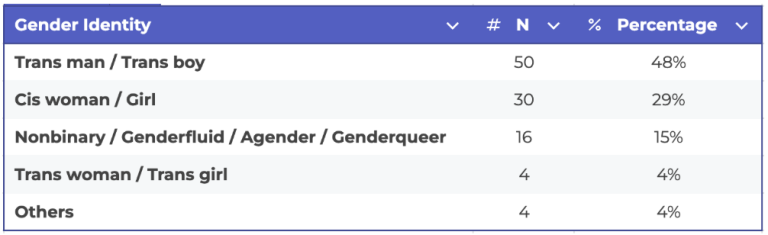
- Sexual/romantic interest: 67% interested in women, 19% in men, 12% in nonbinary/genderfluid persons
- Relationship status: 50% single, 37% with a female partner, 10% with a male partner
- Out to: 65% had disclosed to friends, 31% to parents, 27% to siblings. Only 4% were open to the public.
Prevalence and Types of Online Gender-Based Violence
Seventy-three percent of the LBQ people surveyed reported experiencing online gender-based violence in the 12 months preceding the survey. This prevalence is nearly 10 percentage points higher than the national prevalence of online GBV against women reported by ActionAid in 2022 (64 percent).
Forms of Online GBV Experienced
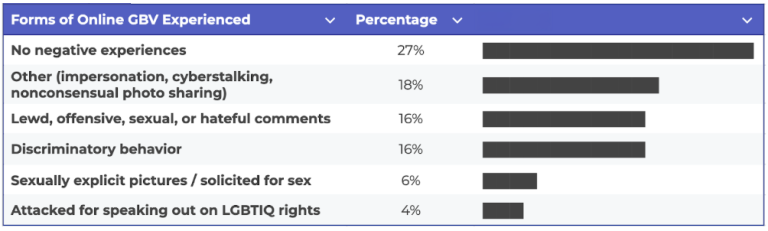
Note: Percentages of 104 total respondents. Multiple responses allowed.
Frequency of Online Gender-Based Violence (Among Those Who Experienced It)

The platforms on which online gender-bas occurred were primarily Facebook (69%), followed by Instagram (20%) and WhatsApp (17%), with other platforms (Snapchat, Telegram, Viber, Discord) accounting for 5%.
All 10 in-depth interview participants reported experiencing online gender-based violence. All had been targeted by online bullying, while many received sexually explicit messages, threatening calls and messages, or nude photos without consent, or experienced cyberstalking, doxing, and loss of access to social media accounts through hacking and blackmail.
Quote from Sabiha
“It happens both inside and outside the [LBQ] community, mostly by the men. When they find out about our orientation, they get fascinated. Oh, she is a lesbian, so let’s explore her… The men who commit these kinds of violence never share their identity. They always use fake accounts.”
Who Are the Perpetrators?
The survey and interview data reveal clear patterns in who commits online gender-based violence against LBQ people in Bangladesh and how they operate.
Relationship with the Perpetrator
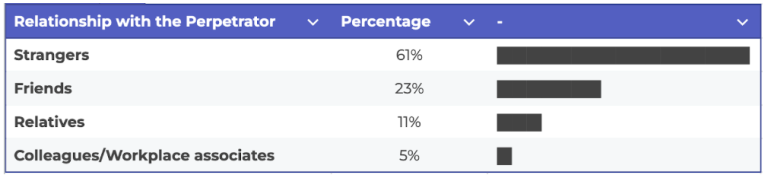
- 42% of perpetrators used anonymous profiles, complicating identification and resolution.
- 61% of perpetrators were not previously known to the respondent.
- When the perpetrator was known, 78% had been acquainted for less than a year.
- The majority of perpetrators were cisgender men.
Perceived Motives
Most perpetrators come from outside LGBTIQ communities and are perceived to be cisgender heterosexual men who perpetrate online abuse through anonymous or fake accounts. Gender nonconformity is perceived as a key motivating factor—perpetrators become hostile when encountering someone not conforming to traditional gender expectations.
Interview participants identified several types of perpetrators: individual men motivated by hostility, curiosity, or a desire to extort; organized religious fundamentalist groups that specifically target LBQ communities; and, in some cases, intimate partners or former partners who weaponize past intimate conversations or photos.
Quote from Khadija
“There is a religious fundamentalist group here in Bangladesh. They have a huge headache about our LBQ community… they will chop us off like anything if we hold a Pride march, or if they see us… When we were preparing for the Pride, we got messages from random people in the group inbox that they would chop us and kill us if we got out.”
Intersecting identities compound the violence. Nupur, a trans man who belongs to a tribal ethnic group, faced intensified harassment because of his gender identity, ethnicity, and political activism combined.
Quote from Nupur
“I don’t think I would face cyber-bullying if I would act like other women, talk like them, or dress like them. But I want to show myself outside what I feel inside. The people who commit these heinous things, most of them are men. They think that the birth of people like us is a sin.”
Impacts of Online Gender-Based Violence
Online gender-based violence takes a devastating toll on LBQ people in Bangladesh, with consequences spanning mental health, physical health, education, career progression, and digital participation.
Mental Health and Well-Being
All 10 interviewees spoke about the impact on their mental health. A significant portion—four out of 10 participants—recounted delayed progress in their education due to mental health instability. All participants noted a drop in their work performance. Some endured physical health issues as a result of mental stress.
Quote from Farzana
“I already had problems with periods. After the incident of harassment that I faced, it got triggered. Heavy bleeding made me anemic… This was a severe physical manifestation of my mental trauma… I had a huge dream and enthusiasm for working dedicatedly and learning. And after that event, I lost all the energy… There was a time I used to think of killing myself.”
Escalation from Online to Offline Violence
Among survey respondents, 19% reported that online violence was linked to preexisting or concurrent offline abuse, while online violence led to offline abuse for 11%. Among interview participants, the pattern was more severe: seven out of 10 participants revealed that their experiences of online GBV escalated into offline abuse, often exacerbating its impacts.
Help-Seeking Behavior and Barriers to Justice
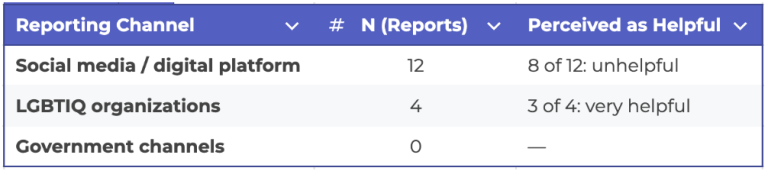
Among the 75 survey respondents who experienced online GBV, only 16 (21%) chose to report the incidents to any organization or entity. No one reported to government channels.
Where Victim-Survivors Reported (N=16)
Why Victim-Survivors Did Not Report
Among the 59 respondents who experienced online GBV but did not report:
- 21% lacked trust in existing systems
- 18% did not know the proper channels for reporting
- 15% chose to handle it themselves or with family/friends
Nine out of 10 interview participants said they lack a safe space to open up about their mental well-being. All expressed a strong desire for counseling support that is friendly and welcoming to their community. When LBQ people do access formal health services, they may face judgment or ignorance from medical professionals.
Quote from Sabiha
“The male doctor slapped me. I was between consciousness and unconsciousness… They pressed me here [pointing to the breast] so badly that I was feeling like dying. They said I was pretending, because mental illness is not an illness, according to them.”
Coping Mechanisms and Resilience
LBQ victim-survivors developed various strategies to protect themselves, often at high cost to their freedom of expression and digital participation:
- 4 of 10 interviewees deactivated social media accounts entirely
- Others removed posts or comments supporting LBQ communities
- Many concealed their sexual orientation, gender identity, or gender expression online
- Respondents shortened friend lists and became cautious about adding unknown individuals
- A significant portion sought alternatives to Facebook due to safety concerns, transitioning to platforms perceived as more secure, like Instagram
Quote from Rebecca
“I never thought too much before posting on Facebook. But now I think at least 10 times before posting anything… I’ve lost my spontaneity… This kind of hatred prevents me from going online. It is not only hampering my social presence, it affects my real life as well.”
Despite these challenges, LBQ interviewees demonstrated remarkable strength and resilience. Two interviewees turned to self-education, learning extensively about sexual orientation and gender identity, which significantly contributed to their mental growth and self-acceptance.
Legal Framework: Gaps in Protection
Bangladesh’s legal landscape presents significant obstacles to addressing online gender-based violence against LBQ people. Several laws are relevant but insufficient or counterproductive:
- Section 377 of the Penal Code: This colonial-era law criminalizes same-sex conduct between men. While technically applicable only to men, it creates an environment of fear that forces all LGBTIQ people to live discreetly and compromises their ability to seek justice.
- Penal Code Sections 354 and 509: These provisions address offenses against women’s “modesty,” but lack precise definitions, rely on patriarchal concepts, and rarely result in filed complaints.
- Digital Security Laws: Bangladesh’s cyber legal regime has undergone multiple reforms—from the ICT Act (2006) to the Digital Security Act (2018), the Cyber Security Act (2023), and the Cyber Security Ordinance (2025)—but each iteration has retained overbroad provisions that grant authorities broad discretionary powers and have been used to target activists and undermine freedom of expression.
- Women and Children Repression Prevention Act (WCRPA): The primary law criminalizing violence against women, but with no specific provisions for LBQ individuals.
Quote from Farzana
“The existing law can’t protect us against online gender-based violence. We have digital security acts that completely go against our LBQ community. It will not give us protection; rather, it will get us arrested at any moment. So, if we want to get protected, we need to decriminalize LGBTQ activity first.”
On a positive note, in 2020, the Bangladeshi police launched Police Cyber Support for Women, a program providing female officers with technical and legal assistance to women victims of cybercrime. There is also cautious optimism around the draft Personal Data Protection Ordinance (2025), which could address some forms of data misuse and privacy violations.
Recommendations
The report offers recommendations across five strategic areas:
1. Creating a Supportive and Inclusive Legal Framework
- The Ministry of Law, Justice, and Parliamentary Affairs should work with LBQ advocacy groups to draft and pass anti-discrimination laws that protect LBQ individuals from online gender-based violence.
- Parliament should decriminalize consensual same-sex conduct.
- Parliament should prioritize legislation addressing online GBV with adequate protection and justice for LBQ victims.
- Social media platforms should adhere to local laws and cooperate with law enforcement in investigating and prosecuting perpetrators.
2. Combating Recurrent Online Gender-Based Violence
- Implement digital literacy and security training programs for LBQ people, in collaboration with LGBTIQ and women’s rights organizations.
- Create user-friendly reporting mechanisms on social media platforms and enforce policies against gender-based violence.
- Conduct specialized training for law enforcement on recognizing, investigating, and addressing online GBV in a human rights-based, non-discriminatory manner.
- Platforms should establish dedicated reporting channels for online GBV, explicitly prohibit GBV related to sexual orientation and gender identity, and promptly investigate and take action against perpetrators.
3. Dealing with Anonymous and Unknown Perpetrators
- Develop platform-wide solutions to disincentivize, deter, detect, and block harmful anonymous behavior while preserving privacy safeguards.
- Advocate for reforms to digital security laws, allowing platforms and authorities to address anonymous online behavior in line with international human rights standards.
4. Strengthening Support from LGBTIQ Organizations
- LGBTIQ organizations should establish community support networks and helplines for LBQ individuals, and provide resources and training on digital safety.
- Social media platforms should engage with LGBTIQ and LBQ organizations to develop and implement reporting systems and provide support for victims.
5. Enhancing Mental Health and Well-Being Support
- Allocate resources for mental health support groups and counseling services specifically tailored for LBQ individuals.
- Mental health professionals should undergo sensitivity training on LBQ issues and create safe, inclusive spaces for LBQ individuals seeking counseling.
Download the Full Report
For the complete findings, in-depth analysis of Bangladesh’s legal framework, full qualitative testimony from LBQ individuals, the survey questionnaire, and interview guidelines, download the full report.
Explore News and Commentaries
We share news, cultural media and advocacy of partners, activists and experts through the lens of LGBTIQ people working on international human rights.
Read Our Insights