

Report
The Global State of LGBTIQ People’s Human Rights in 2025
Region(s)
Author(s)
Publish Date
January 26, 2026
Share
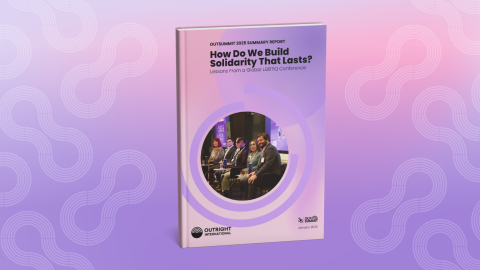
In November 2025, 574 LGBTIQ activists, civil society leaders, diplomats, donors, and allies from over 70 countries gathered for Outsummit 2025—Outright International's flagship global conference. Against a backdrop of escalating attacks on LGBTIQ people’s human rights worldwide, participants shared strategies, celebrated victories, and confronted a critical question: "How do we build solidarity that lasts?"
This summary report captures the key insights, regional success stories, and actionable lessons from all five thematic sessions.
The Global State of LGBTIQ People’s Human Rights in 2025
The past year has tested LGBTIQ movements worldwide. As Maria Sjödin, Executive Director of Outright International, stated at the conference opening:
Quote from Maria Sjödin
"We are facing the worst backlash globally ever for LGBTIQ people. In 2024, 85 percent of the countries that we looked at that had elections had anti-LGBTIQ messages in their campaigns. There's a funding crisis. This backlash is very real, and I don't think we have seen the peak of it yet."
Outsummit 2025 also marked Outright International's 35th anniversary, providing a critical moment to reflect on both the gains and losses of the global movement—and to chart a path forward.
Conference Highlights: 5 Key Themes
Outsummit 2025 was organized around five thematic sessions, each addressing a pressing challenge facing the global LGBTIQ movement.
1. Our Rights Under Siege: The Global Attack on Trans, Nonbinary, and Intersex People's Human Rights
Outright International launched its new report and interactive map tracking legal and policy restrictions on trans, nonbinary, and intersex people's rights across 15 countries. Panelists examined how anti-gender movements are coordinating transnationally, sharing playbooks, fake news, and political strategies across borders.
Key findings from this session:
- Governments in 15 countries proposed or enacted laws restricting gender-affirming care, codifying binary sex definitions, rolling back gender recognition, and censoring LGBTIQ expression.
- The U.S. withdrawal of support for LGBTIQ equality has emboldened anti-gender actors globally.
- Anti-LGBTIQ attacks are part of a broader assault on democracy, gender equality, and human rights. At the United Nations, anti-gender movements are working to remove LGBTIQ-inclusive language and undermine international human rights law.
What advocates are saying:
Quote from Rikki Nathanson
"The bathroom is no longer just a necessity; it's a battlefield. The doctor's office is not a place of healing, but a site of interrogation. When politicians draft laws about who we are, they aren't just passing laws; they are imposing a narrative of shame and invisibility."
Key lessons for advocates:
- Transnational attacks require transnational solidarities—share information and resources across borders.
- Broaden the agenda beyond civil and political rights to include economic, social, and environmental rights.
- Center human stories in advocacy to counter dehumanizing narratives.
- Build slow, steady, long-term engagement to change hearts and mindsPrioritize collective care as resources become scarce.
2. Moving the Needle: Humanitarian Inclusion, Legal Reform, and Visibility
Despite significant setbacks, 2025 was also a year of victories. Activists shared success stories from Asia, the Eastern Caribbean, Ghana, Hungary, and Ukraine.
Regional Success Stories:
Asia: Courts Uphold Trans People's Rights Courts across Asia built on legal precedents to protect trans people's rights:
- India secured rulings affirming parental rights for trans people, domestic violence protections for trans women, and the right to accurate identity documents.
- Japan's Sapporo Family Court struck down a law requiring trans people to change their genitals' appearance to access legal gender recognition.
- Hong Kong affirmed the right to access public bathrooms in accordance with one's gender identity.
Saint Lucia and the Eastern Caribbean: Decriminalization Victory In July 2025, Saint Lucia struck down a colonial-era law criminalizing same-sex intimacy—the result of ten years of regional planning, security preparation, and coalition-building. This victory is part of a broader trend: five Caribbean islands have now successfully challenged criminalization through the courts.
Ghana: Intersex Visibility Breakthrough Intersex activists achieved groundbreaking visibility through national media coverage, community outreach, and regional coalitions. They successfully lobbied to remove "intersex" from a proposed anti-LGBT bill and partnered with UNDP to develop regional guidance on intersex health and human rights in Africa.
Hungary: Largest Pride in History Despite a government ban, the Budapest Pride March of June 2025 became the largest Pride event in Hungarian history and one of the country's biggest public demonstrations. Over 70 Members of the European Parliament joined local activists to ensure the event's safety and visibility.Ukraine: LGBTIQ Inclusion in Humanitarian Response Through sustained advocacy, Ukrainian activists secured the first-ever LGBTIQ technical working group within the UN humanitarian protection cluster—ensuring LGBTIQ needs are formally addressed in aid, evacuation, and recovery planning.
Key lessons for advocates:
- Strategic wins require long-term, locally led planning.
- Visibility shifts power—showing up publicly transforms narratives.
- Legal change must be matched with cultural change to prevent rollbacksInclusion must be enforceable, not symbolic.
3. Inclusive Economies: The Business Case for LGBTIQ Inclusion and LBQ Economic Resilience
Economic inclusion advances rights, safety, and dignity. This session examined why diversity, equity, and inclusion (DE&I) matters for business, and how lesbian, bisexual, and queer (LBQ) women are achieving economic self-sufficiency.
The Business Case for LGBTIQ Inclusion
Brent Miller of Procter & Gamble emphasized that inclusion is a core driver of business growth: "When you wire it into part of your growth strategy, it becomes something that you can sustain. It must be something that's built into the fabric and the culture of what you do versus bolted on."
The LBQ Funding Gap
Only approximately 5% of global LGBTIQ funding goes to LBQ groups—despite LBQ communities demonstrating exceptional entrepreneurial capacity when invested in.
Models of LBQ Economic Resilience:
- Microfinance in Southern Africa: A social enterprise provides interest-free business loans to LBQ entrepreneurs, who then hire other queer people as they grow.
- Digital Skills Training in Kenya: Utopia Network offers digital marketing, financial literacy, and business training for LBQ women entrepreneurs in Mombasa.
- Community Exchange Spaces: "Thriving Thursdays" in Kenya provides a storytelling space where LBQ women share business journeys and success stories.
Key insight from Wakio Mwandacha of Utopia Network Kenya: "Economic inclusion, particularly for the LBQ community, is about access, yes, but it is also about validation. It's about validating our models of reality, how we define success, how we define safety, or even how we define leadership."
4. We Are Pro-Family, We Are Pro-Children: Reclaiming the Narrative
Anti-gender movements have weaponized "family values" rhetoric to attack LGBTIQ people’s human rights. This session examined how activists are reclaiming the narrative, demonstrating that LGBTIQ equality is not antithetical to children and families—it is essential to protecting them.
Exposing the "Pro-Family" Strategy
Lopa Banerjee of UN Women traced how "protecting the family" rhetoric has roots in colonial law, nationalism, and authoritarianism: "The idea of protecting the family harks back to a history where the hegemonic state and the normative family are intertwined as instruments of control."
The Reality: Inclusive Policy Protects Children
- In Jamaica, more than a third of LGBTQ Jamaicans experienced bullying in school, with teachers less likely to intervene.
- Intersex infants remain among the most harmed by exclusionary policies, with many governments allowing unnecessary genital surgeries while banning medically necessary gender-affirming care for trans youth.
- Children of LGBTIQ families face discrimination and a lack of legal protections.
Case Studies in Family Rights:
Taiwan: Despite becoming the first Asian country to recognize same-sex marriage in 2019, same-sex couples still face barriers to assisted reproduction and adoption. As Shing Li of Taiwan LGBT+ Family Rights noted: "Laws can change quickly, but the culture takes time."
Nepal: Following a 2023 Supreme Court order for temporary same-sex marriage registration, implementation remains difficult due to a lack of clear mechanisms and public awareness.
The Counter-Strategy: Reclaim the Narrative
Activists emphasized sharing stories, lifting up LGBTIQ parents, focusing on love and care, and grounding advocacy in local cultural frames. In Hungary, activists highlighted government cover-ups of sexual abuse in state care facilities, demonstrating that it is exclusionary policies—not LGBTIQ people—that harm children.
5. Bridging the Rainbow: A Global LGBTIQ Intergenerational Dialogue
Marking Outright's 35th anniversary, this session brought together pioneering activists and younger leaders to discuss intergenerational collaboration, knowledge transfer, and movement sustainability.
Challenges Facing Younger Activists
Younger activists inherit tools, structures, and terminology—but often not power. Glenroy Murray from Jamaica shared: "It was very difficult to find legitimacy as a younger voice. I was contending with older activists who just decided that my youth was enough to dismiss me."
Learning from Movement History
As governments withdraw support and funding dries up, younger activists can learn from early organizing strategies. Julie Dorf, Outright's co-founder, noted: "We knew how to organize old school with not just fax machines, but with telephone answering machines that told you where to show up the next day for the protest."
The Path Forward
Court(ney) Felle from interACT posed the central question: "How do we move [social media] relationships into individual friendships or in-person gatherings or some sort of actual coalition? You can use that to connect with each other, but it can't just end there. How do we build a solidarity that lasts?"
Key insight from Julie Dorf:
Quote from Julie Dorf
"I've watched us go from kind of pre-identity politics to micro-identity politics, and I think we're finally coming out of that into something a little more holistic, a little bit more genuinely intersectional. We're going somewhere liberatory and exciting and queer and joyful."
Conference at a Glance
Metric
In-Person Attendees
Online Attendees
Total Participants
Countries Represented
Thematic Sessions
Years of Outsummit
Number
171
403
574
70+
5
11
Key Takeaways for LGBTIQ Advocates, Donors, and Policymakers
- Transnational coordination is essential. Anti-gender movements share playbooks across borders—so must advocates.
- Legal victories require cultural change. Laws alone cannot sustain progress without shifting hearts and minds.
- Invest in LBQ economic resilience. With only 5% of LGBTIQ funding, LBQ communities are dramatically under-resourced despite proven entrepreneurial capacity.
- Reclaim family and children narratives. LGBTIQ equality protects families and children—exclusion harms them.
- Bridge generational divides. Transfer not just knowledge and tools, but power and leadership opportunities to younger activists.
- Build solidarity that lasts. Short-term coalitions are not enough. Sustainable movements require long-term relationship building across issues, regions, and generations.
Download the Full Report
The complete Outsummit 2025 Summary Report includes detailed session summaries, speaker quotes, and actionable recommendations for advancing LGBTIQ people’s human rights globally.
Frequently Asked Questions (FAQ)
What is Outsummit?
Outsummit is Outright International's annual global LGBTIQ human rights conference. Now in its 11th year, Outsummit brings together activists, civil society leaders, diplomats, donors, and allies to exchange strategies, share success stories, and build solidarity across regions. Outsummit 2025 was held on November 7, 2025, both in person and online.
What was the theme of Outsummit 2025?
The 2025 theme was "How Do We Build Solidarity That Lasts?" Against a backdrop of intensifying global backlash against the human rights of LGBTIQ people, participants explored how to sustain movements, build durable coalitions, and achieve lasting change.
How many people attended Outsummit 2025?
Outsummit 2025 brought together 574 participants: 171 attended in person and 403 joined online. Attendees represented over 70 countries and included LGBTIQ activists, civil society representatives, diplomats, funders, and allies.
What topics were covered at Outsummit 2025?
The conference featured five thematic sessions:
- Our Rights Under Siege – Anti-gender attacks on trans, nonbinary, and intersex people's human rights
- Moving the Needle – LGBTIQ success stories from 2025
- Inclusive Economies – The business case for LGBTIQ inclusion and LBQ economic resilience
- We Are Pro-Family, We Are Pro-Children – Reclaiming narratives weaponized by anti-gender movements
- Bridging the Rainbow – Intergenerational dialogue and movement sustainability
What were the major LGBTIQ victories highlighted at Outsummit 2025?
Key victories included:
- Saint Lucia decriminalizing same-sex intimacy after a decade of advocacy
- Courts in India, Japan, and Hong Kong upholding trans people's rights
- Budapest Pride becoming the largest in Hungarian history despite a government ban
- Ukraine establishing the first LGBTIQ technical working group in a UN humanitarian response
- Ghana's intersex movement achieving groundbreaking national visibility
What is the current state of global human rights of LGBTIQ people?
According to data presented at Outsummit 2025, LGBTIQ communities face an intensifying global backlash. In 2024, 85% of countries with elections featured anti-LGBTIQ campaign messaging. Across 15 countries tracked by Outright, governments proposed or enacted laws restricting trans people's rights, rolling back gender recognition, limiting gender-affirming care, and censoring LGBTIQ expression. Funding for LGBTIQ organizations has also decreased significantly.
What is the "anti-gender movement"?
The anti-gender movement refers to a coordinated, transnational network of actors working to roll back rights for LGBTIQ people, women, and other marginalized groups. These movements share strategies, messaging, and resources across borders, often using "protecting children" and "pro-family" rhetoric to justify exclusionary policies.
How much global funding goes to LBQ (lesbian, bisexual, queer women) organizations?
According to data cited at Outsummit 2025, only approximately 5% of global LGBTIQ funding goes to LBQ-specific groups—despite LBQ communities demonstrating significant entrepreneurial capacity and community-building when invested in.
What is the 'Attack on Trans People's Rights' Interactive Map?
At Outsummit 2025, Outright launched a new report and interactive map tracking legal and policy restrictions on trans, nonbinary, and intersex people's rights in 15 countries. The map visualizes restrictions on gender-affirming care, legal gender recognition, freedom of expression, and other rights.
Why is intergenerational collaboration important for LGBTIQ movements?
Outsummit 2025's intergenerational panel highlighted that younger activists often inherit tools and structures but not decision-making power, while older activists hold institutional knowledge that risks being lost. Effective movements require transferring not just knowledge but leadership, combining the strategic wisdom of experienced activists with the innovation and energy of younger generations.
How can I access the full Outsummit 2025 Summary Report?
The complete report is available for free download on this page. It includes detailed session summaries, speaker quotes, and recommendations for activists, policymakers, and funders.
How can I support Outright International's work?
You can support Outright by:
- Donating to fund global LGBTIQ advocacy
- Sharing this report and Outright's resources
- Following Outright on social media
- Attending future Outsummit conferences
Will there be an Outsummit 2026?
Stay tuned for announcements about Outsummit 2026. Sign up for Outright's newsletter to receive updates on future convenings and opportunities to participate.
Who can I contact for media inquiries about Outsummit 2025?
For press inquiries, interview requests, or additional information, please contact Outright International's communications team at [email protected].
Explore News and Commentaries
We share news, cultural media and advocacy of partners, activists and experts through the lens of LGBTIQ people working on international human rights.
Read Our Insights