

Report
They Endure the Violence Alone
Region(s)
TOPIC(s)
Author(s)
Publish Date
February 20, 2026
Share
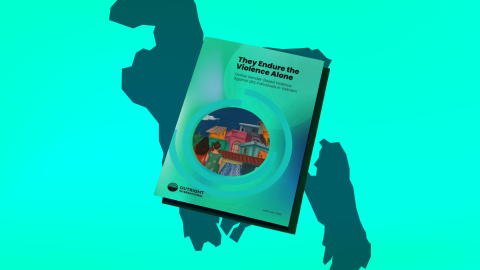
“They Endure the Violence Alone” is a study documenting the experiences, impacts, and responses of LBQ women and people facing technology-facilitated gender-based violence in Vietnam.
KEY FINDINGS AT A GLANCE
About This Report
This report on Vietnam is part of a series that explores online gender-based violence against an often-ignored group of victims—lesbian, bisexual, and queer (LBQ) women and people. Attacks on LBQ people online are shaped by both misogyny and homophobia and take distinct forms that are currently missing from the literature on technology-facilitated, gender-based violence.
Beginning in 2023, Outright International undertook a study across five Asian countries—Bangladesh, Indonesia, Malaysia, the Philippines, and Vietnam—surveying and interviewing close to 500 respondents for a first-of-its-kind look at queer women’s experiences of gender-based violence online.This report shares findings from Vietnam, based on 100 LBQ survey responses and 12 key informant interviews, and offers recommendations to policymakers and other stakeholders.
Context: Rights of LGBTIQ people and Online Spaces in Vietnam
Over the last decade, the visibility of LGBTIQ people and movements in Vietnam has expanded rapidly through advocacy efforts by civil society organizations. Pride events have multiplied across the country since the first VietPride in Hanoi in 2012, and LGBTIQ communities networks, organizations, and advocates are increasingly visible and vocal.
These efforts have led to increased recognition of LGBTIQ people’s human rights. Vietnam officially lifted its ban on same-sex marriage in 2014, though these marriages remain unrecognized under the law. The amended Civil Code (2015) set a legal foundation for citizens to modify their gender marker on identification documents. In 2022, the Ministry of Health issued an official dispatch stating that homosexuality is not a disease, affirming World Health Organization guidelines and prohibiting discrimination by health care providers.
Despite these positive changes, Vietnamese people of diverse sexual orientations, gender identities and expressions, and sex characteristics continue to face discrimination in public and private spheres, as well as legal barriers to equality. Same-sex partnerships remain unrecognized by law. Transgender persons’ rights remain in a state of legal uncertainty—a proposed Gender Affirmation Law has been in development since 2017, but has not been approved by the legislature.
Over 79 percent of Vietnam's population has access to the internet, with nearly 73 million active social media users as of January 2024. On average, Vietnamese people spend nearly seven hours a day on the internet. In 2020, Microsoft’s Digital Civility Index ranked Vietnam among the countries with the highest risks of exposure to negative experiences online, with 30 percent of negative online interactions involving conflicts, harassment, or discriminatory behavior linked to people’s sexual orientation.
Who Participated in This Study
The online survey collected 100 valid responses from LBQ individuals across Vietnam, complemented by 12 in-depth key informant interviews with LBQ community members and stakeholders, including counselors, activists, health professionals, educators, and UN staff.
Respondent Demographics
- Age: The average age was approximately 25.8 years, with 53% of respondents in the 20–24 age group.
- Location: 83 respondents live in urban areas, with 72 based in Ho Chi Minh City and Ha Noi. Only 17 were based in rural, suburban, or mountainous areas.
- Education: 86 of 100 respondents have a college, university, or postgraduate degree.
- Ethnicity: 93 respondents are from the majority Kinh (Viet) ethnic group. Six belong to ethnic minority groups, including the Tay, Thai, Mong, Cham, and Hoa communities.
Types of Online Gender-Based Violence Faced by LBQ People
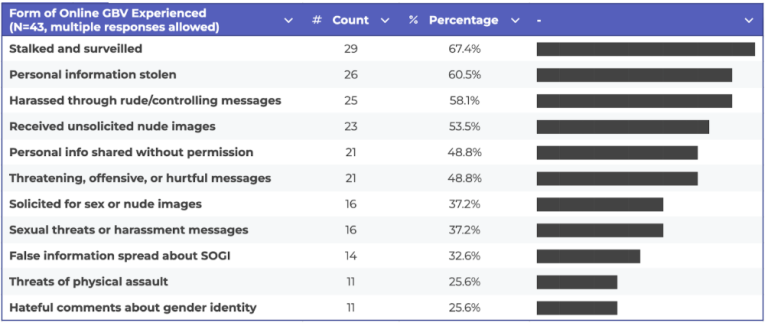
Among the 43 victim-survivors, respondents experienced multiple overlapping forms of online gender-based violence. Stalking and surveillance was the most commonly reported form, followed by personal information theft and harassment through controlling or intimidating messages.
Forms of Online GBV Experienced (N=43, multiple responses allowed)
Online Sexual Harassment
Qualitative data from key informant interviews confirms that online sexual harassment against LBQ people continues to be prevalent, including within LBQ communities themselves. LBQ people who are trans experience compounded harm—facing transphobia on top of sexism and homophobia, including the fetishization of trans bodies under the guise of “curiosity.”
Activists working with LBQ communities reported that sexual jokes, unwanted private questions about sex life, and pressure to discuss sexual experiences are common in private online groups. This underscores the need to raise awareness about online gender-based violence not only among the general public but also within LBQ communities.
Hurtful and Homophobic Messages
Participants received hurtful direct messages and hateful comments pertaining to their sexual orientation. They were branded as “deviants” and “bad persons” who “spoil” the tradition of the country because their relationships deviated from cisheteronormative standards. Perpetrators used slurs to humiliate LBQ people.
Quote from Bich Tram
“One day, I posted a photo, and a complete stranger texted me, ‘What a girl! You don’t look like a proper girl, and you love girls who destroy Vietnam’s fine tradition.’ They sent me a long message… ‘you’re living a wrong life, you are at the bottom of society.’”
Impacts of Online Gender-Based Violence on LBQ People
Online gender-based violence impacts LBQ survivors across multiple dimensions of their lives—from mental and physical health to work, education, and the freedom to express their sexual orientation and gender identity. The harm extends far beyond cyberspace.
Impact on Mental Health
Psychological Impacts Reported by Victim-Survivors (N=43)
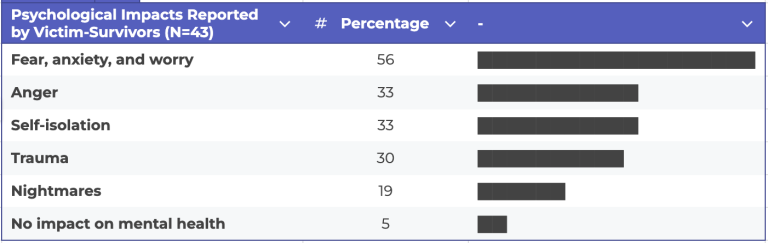
Note: Percentages represent the proportion of 43 victim-survivors. Multiple responses allowed.
Impact on Physical Health
Victim-survivors experienced significant physical health consequences:
- Fatigue: 56% of victim-survivors (24 respondents)
- Insomnia: 37% (16 respondents)
- Anorexia: 33% (14 respondents)
- Physical injury (linked to online behaviors leading to offline abuse): 21% (9 respondents)
Impact on Work and Education
The harm of online gender-based violence extends into professional and educational life. Among 43 victim-survivors, 47% (20 respondents) reported being distracted at work or school, 33% (14 respondents) experienced reduced productivity, 9% (4 respondents) saw reduced learning outcomes, 7% (3 respondents) needed to take time off from work or school, and 5% (2 respondents) lost their jobs.
Impact on Freedom to Express Sexual Orientation and Gender Identity
Nearly half of victim-survivors (20 people) reported that the incident led them to conceal their sexual orientation. Nearly one-third (12 people) reported that it led them to conceal their gender identity. Interview data reveal that victim-survivors sometimes internalize queerphobia, buying into negative norms around sexual orientation and making justifications for the acts of online violence perpetrated against them.
Quote from Xuan
"Suddenly, someone attacked my physical appearance. Within one to two weeks, it triggered my gender dysphoria significantly."
Impact on Will to Live
The most alarming finding concerns the impact on victim-survivors’ will to live:
Who Are the Perpetrators?
The primary perpetrators identified in the survey included strangers or people with anonymous profiles, virtual friends (including members of online forums, LGBTIQ communities groups, and social networking sites), and other friends known through the internet. Former romantic partners were also reported at high rates.
Key perpetrator findings:
- 79% of reported perpetrators were cisgender men, aligning with common patterns seen in other forms of gender-based violence.
- 29% of cases involved cisgender women perpetrators.
- For identity theft, 61.5% of cases were committed by strangers or anonymous users.
- Former partners were particularly associated with threatening, offensive, or hurtful messages (19% of those cases).
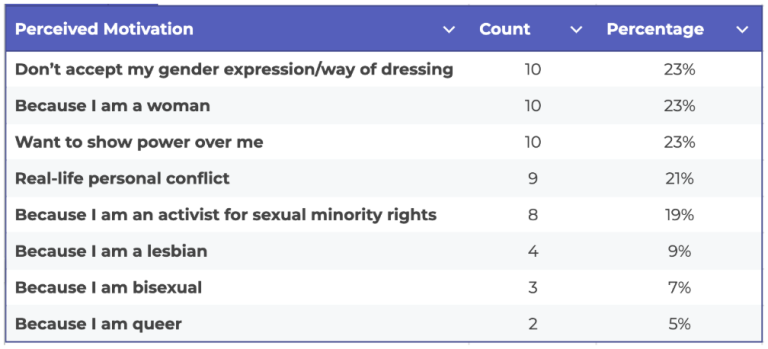
Perceived Motivations
Respondents identified multiple motivations behind the violence they experienced. The most commonly perceived purposes were to instill fear and shame (37% each), to manipulate others into slandering or humiliating the victim (30%), and to pressure victims to comply with perpetrators’ desires (30%). Notably, some perpetrators appeared to be motivated by a desire to “change” victim-survivors’ sexual orientation or gender identity to conform to cisheteronormative standards.
Responses to Online Gender-Based Violence and Barriers to Seeking Help
Very few victim-survivors seek professional help or report incidents to authorities. Instead, most changed their online habits and turned to friends and family. Among the 12 key informant interviews, none reported seeking help from professional services.
Changing Internet Behavior
Following their experience of online gender-based violence, victim-survivors made significant changes to how they use the internet:
- 56% began sharing less about their private life
- 49% blocked the perpetrator
Some victim-survivors became less active on social media, limited their friend lists, created alternative accounts with smaller circles, or switched to platforms they perceived as safer, such as LinkedIn instead of Facebook.
Who Did Victim-Survivors Turn To?
Only 23 of 43 victim-survivors (53%) sought support from anyone. Among those who did:
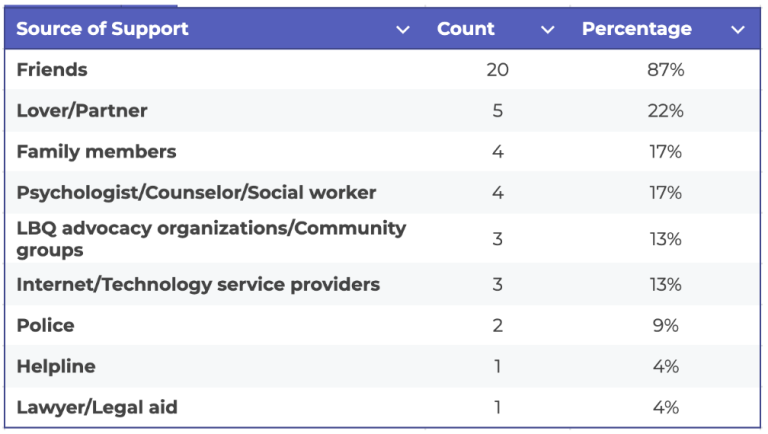
Barriers to Seeking Support
Among the 20 victim-survivors who did not seek support, the most common reasons were:
- 30% believed no one could help
- 15% had no information about available support
- 15% were too ashamed to seek help
- 10% feared revenge from the perpetrator
Key informants highlighted additional systemic barriers: a pervasive culture of victim-blaming, lack of trust in service providers, fear of being outed, unclear reporting mechanisms, and the perception that LBQ voices are less likely to be heard or taken seriously by authorities. Existing support services serve gender-based violence victim-survivors in general but lack LGBTIQ-focused programs and communications.
Quote from Kim Chung
“Before looking at the problem, people will look at that group, who is the person speaking up, and this voice in our community is the voice that is more restricted, a voice that is less listened to, and a voice that is more stigmatized.”
Vietnam’s Legal Framework: Gaps in Protection
The report analyzes several Vietnamese laws through three human rights lenses—the right to privacy, the right to gender equality, and the right to life, liberty, and personal security. The analysis reveals significant gaps that leave LBQ people vulnerable to online gender-based violence:
- Law on Gender Equality (2006): Relies on a binary gender framework recognizing only “men” and “women,” effectively excluding individuals with diverse gender identities. Does not define or specify acts of gender-based violence.
- Criminal Code (2015): Article 288 can apply to some forms of online GBV, but only if financial harm (100 million VND/US$3,780) or reputational damage occurs, making it harder for victims to seek justice when harm is psychological.
- Cybersecurity Law (2018): Broad and vague provisions could carry risks for LGBTIQ people and activists, including potential censorship, surveillance, and deplatforming. Does not define “gender” or reasonably delimit prohibited acts.
- Domestic Violence Prevention Law (2022): Since same-sex marriages are not recognized, same-sex domestic relationships fall outside the law’s protection.
- Code of Conduct on Social Networks (2021): References undefined “moral standards” and “moral values” that could be used to disfavor LBQ individuals. It is a non-binding document.
The report also analyzes platform-level protections on Facebook and Zalo, Vietnam’s top social media platforms. Zalo’s terms of use lack specificity on gender-based violence and do not prohibit discriminatory language based on gender identity or sexual orientation. Facebook’s parent company, Meta, rolled back LGBTIQ protections in January 2025, explicitly allowing content that characterizes LGBTIQ identities as mental illness and advocating for the exclusion of trans people from single-sex spaces.
Recommendations
To address online gender-based violence against LBQ people in Vietnam, the report offers recommendations to four groups of stakeholders:
To the Government of Vietnam
Legal and Policy Reform
- Collaborate with civil society organizations and victim-survivors’ groups to develop an agreement on a definition of online gender-based violence at the national level, aligned with international human rights standards.
- Ensure relevant laws and policies do not reinforce binary gender and heteronormative standards, to fully recognize the diversity of sexual orientations, gender identities, gender expressions, and sex characteristics.
Incorporate online gender-based violence into relevant laws and policies aimed at combating gender-based violence. - Broaden the scope of the Law on Cybersecurity to protect and promote human rights, especially the right to access cyberspace free from gender-based violence.
- Build the capacity and skills of health care providers, legal aid officers, and relevant agencies in identifying and addressing cases of online GBV against LBQ individuals in a sensitive and non-discriminatory manner.
- Develop a clear and accessible reporting protocol and mechanism for online gender-based violence.
Strengthening Data Collection
- Document instances of online GBV against LBQ persons and other persons with diverse SOGIESC in the next national studies on gender-based violence.
Public Awareness
- Raise awareness about online GBV, including its serious impacts on LBQ and other marginalized communities.
- Enable educational institutions to incorporate LGBTIQ-inclusive lessons on online gender-based violence into curricula.
To UN Agencies and Civil Society Organizations
- Support the Government in reviewing and reforming relevant laws and policies on gender-based violence.
- Support the development of a shared national definition of online GBV aligned with international human rights standards.
- Conduct more studies on online GBV against LBQ persons at the local and national levels.
- Organize campaigns to raise awareness at different levels, including at the grassroots level and with government agencies, private companies, and non-profit organizations.
- Engage in evidence-based advocacy for law and policy reform.
To Educators and Researchers
- Conduct more studies on online GBV against LBQ and other persons with diverse SOGIESC to provide evidence for advocacy.
- Integrate comprehensive sexuality education into school curricula to build understanding of the diversity of sexual orientations, gender identities, gender expressions, and sex characteristics.
- Integrate instruction on LGBTIQ-responsive service provision for students pursuing degrees in social work, psychology, and other relevant fields.
To Social Media and Other Online Platforms
- Consult community groups and civil society organizations to develop supplementary terms of agreement and other policies and mechanisms to prevent and respond to online gender-based violence against persons with diverse sexual orientations, gender identities, and gender expressions.
Download the Full Report
For the complete findings, in-depth analysis of Vietnam’s legal framework, full qualitative testimony from LBQ individuals and stakeholders, and the research survey questionnaire, download the full report.
Explore News and Commentaries
We share news, cultural media and advocacy of partners, activists and experts through the lens of LGBTIQ people working on international human rights.
Read Our Insights