

Report
“We Need People In, Not Out”
Region(s)
TOPIC(s)
Author(s)
Publish Date
January 26, 2026
Share
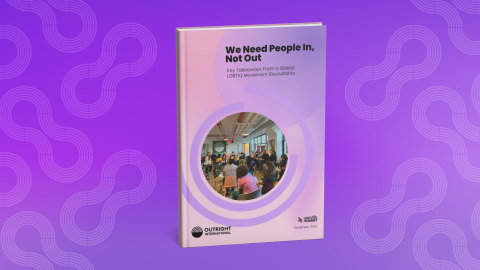
Key Takeaways From a Global LGBTIQ Movement Roundtable
What this briefing paper is
On November 6, 2025, on the sidelines of Outsummit 2025, Outright International convened an internal movement roundtable with over 40 LGBTIQ activists, civil society representatives, and partners from 14 countries. The discussion was held under the Chatham House Rule to encourage frank exchange and protect participants’ safety.
This briefing paper summarizes the roundtable’s key takeaways and practical best practices across three themes:
- Responding to the funding crisis
- Building effective narratives
- Forging alliances
The paper is based on rapporteur notes taken during the session, with quotes reconstructed to the best of the rapporteur’s ability and not attributed to individuals.
Why this matters now
The global LGBTIQ movement is facing a convergence of threats. As funding contracts and uncertainty grows, anti-gender movements are escalating discriminatory laws, hostile coalitions, and coordinated narratives designed to shrink civic space and restrict what can be said or defended in public life.
Participants described the current funding environment as one of the most severe challenges in years. The roundtable captured what movements are doing in real time: adapting how resources move, repurposing infrastructure for safety and care, simplifying and localizing language to reach wider publics, and building alliances that can hold under pressure. This is not a single roadmap. It is a set of grounded lessons and strategies shared across contexts.
What you’ll find inside
1) Responding to the funding crisis
How abrupt funding shocks are reshaping movement infrastructure, increasing burnout, and accelerating instability. The paper highlights tested approaches, including diversifying funding pathways, collaborating across movements, building pro bono legal partnerships, and repurposing community infrastructure to sustain care, safety, and organizing.
2) Building effective narratives
Why far-right narratives spread so effectively (simple, consistent, emotionally charged, and transnational), and how movements can respond without getting trapped in defensive messaging. The paper surfaces best practices around localizing language, building shared value frames, reclaiming terms strategically, making messages inviting, and testing what lands with real audiences.
3) Forging alliances
Why alliances often form after crisis hits, and what it takes to build durable coalitions before the next emergency. The paper includes practical steps for mapping potential allies, rebuilding bridges with feminist and gender justice movements, engaging unexpected partners where possible, and grounding coalitions in shared experiences of exclusion and shared goals.
Key takeaways at a glance
Three themes recur throughout the roundtable:Movements are innovating under constraint. As traditional pathways narrow, groups are experimenting with shared infrastructure, new funding channels, community resourcing, and strategies that reduce dependency.
Narrative is infrastructure. Participants stressed that the “terms of debate” are being actively narrowed, especially on trans and intersex people’s rights. Narrative strategy and message testing are central to building public support and protecting political space.
Alliances must be built early. Declining resources make coalition-building more urgent, not optional. The most durable alliances are long-term and values-based, not transactional or crisis-specific.
How the roundtable worked
The roundtable was structured as three 40-minute “fishbowl” discussions, one for each theme. Four to five participants, prioritizing frontline activists, opened each discussion. The circle then opened for others to join, supporting exchange across activists, Outright staff, funders, and institutional partners.
The session was held under the Chatham House Rule to support candor and protect participants’ safety.
Who this briefing paper is for
This briefing paper is designed for:
- Activists and movement organizations seeking practices that have worked across contexts.
- Funders who want to support sustainability, narrative resilience, and alliances without increasing risk for partners.
- Policymakers and allies looking to understand the realities behind funding shocks and political volatility.
- Researchers, journalists, and observers tracking transnational anti-gender backlash and civil society resilience.
Frequently Asked Questions (FAQ)
What is this briefing paper?
A summary of key takeaways from an internal movement roundtable convened by Outright on November 6, 2025, alongside Outsummit 2025. It captures challenges and best practices shared across funding, narratives, and alliances.
Who participated?
Over 40 LGBTIQ activists, civil society representatives, and partners from 14 countries participated, alongside Outright staff and a small number of funders and institutional partners. Individuals are not named for safety.
Why are quotes anonymous?
The session was held under the Chatham House Rule to enable frank discussion, especially for participants working in hostile or criminalizing contexts. Quotes were reconstructed from rapporteur notes and are not attributed to named individuals.
Is this a universal strategy for every country or movement?
No. The paper reflects diverse perspectives and does not claim to be a single blueprint. It offers adaptable lessons and practices that can be tailored to local context.
What are the main themes covered?
- Responding to the funding crisis and reducing dependency
- Building narratives that reach broader publics without compromising values
- Forging alliances that can hold under pressure and across movements.
Can I share or reproduce this briefing paper?
Yes, within the terms of the CC BY-NC-ND 4.0 license: you can share it for nonprofit administrative or educational use, without altering it, with proper attribution.
How should funders use this briefing paper?
As a practitioner-informed guide to what movements say they need now: flexible support, safety-conscious funding, investments in sustainability and narrative capacity, and resourcing long-term coalition work.
How do I contact Outright about this briefing paper?
Download
Explore News and Commentaries
We share news, cultural media and advocacy of partners, activists and experts through the lens of LGBTIQ people working on international human rights.
Read Our Insights