

Report
"We Will Not Bow to Fear": Pride Around the World in 2025
Region(s)
TOPIC(s)
Author(s)
Publish Date
June 18, 2026
Share
In 2025, LGBTIQ movements showed the world what it looks like to refuse to disappear.
Public Pride took place in 101 countries. State crackdowns, funding cuts, and political hostility intensified everywhere. Communities held Pride anyway, knowing the costs.
This is Outright International's sixth annual report on where and how the world marked Pride.
What the 2025 data shows. Public-facing Pride or LGBTIQ visibility events took place in 101 of the world's 193 UN member states in 2025. In 92 member states, no public Pride was held. In at least 66 countries, Pride happened in more than one city, beyond the capital, a sign of movements putting down roots in small towns and rural communities.
The report draws on 122 survey responses from 59 countries in seven languages and 30 in-depth interviews with LGBTIQ and asexual human rights activists. It documents a year marked by intensifying political hostility, state crackdowns, and a sharp contraction in funding for LGBTIQ work worldwide.
By The Numbers
Pride around the world in 2025
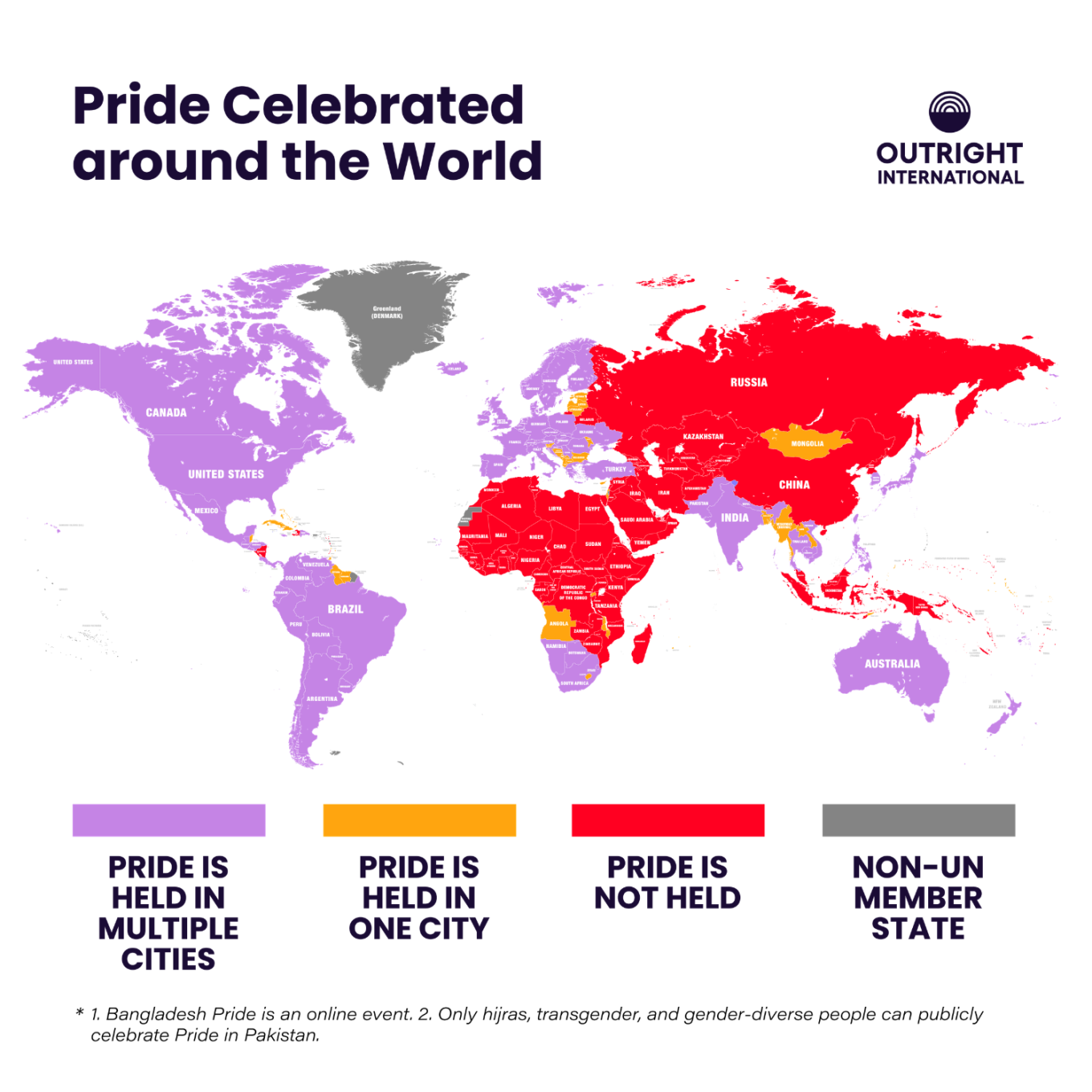
What this tells us. The number of countries holding public Pride has stayed fairly consistent year to year. The clearer trend is decentralization: more countries are holding Pride in more than one city. First-time events in small towns and rural areas point to homegrown ownership and broadening acceptance, even as crackdowns grow more varied and more sophisticated.
In March 2025, Hungary's parliament outlawed Pride assemblies. Budapest Pride organizers reframed the march as a municipal cultural event hosted by the city's mayor, bringing an estimated 350,000 people onto the streets on June 28. It was the largest human rights demonstration the country has ever seen. In October, the city of Pécs held its own Pride in defiance of a police ban upheld by the Supreme Court. Six thousand people marched in a city of 100,000. The slogan: "We Will Not Bow to Fear."
On July 29, 2025, the Eastern Caribbean Supreme Court struck down Saint Lucia's colonial-era law criminalizing consensual same-sex conduct between men. Organized by 758 Pride, the movement used the moment to celebrate and to expand its public education and advocacy work.
Pride reached Palapye, Botswana, the country's first public Pride outside the capital. It reached Puerto Varas and the Atacama region of Chile, and the small town of Waverly, Iowa, in the United States. In Pakistan, trans and gender-diverse communities took part in women's rights marches beyond Lahore.
Pride was banned in cities including Pécs, Oradea in Romania, Chișinău in Moldova, and Çanakkale in Türkiye. In Istanbul, where Pride has been banned since 2015, police arrested up to 53 people for marching in 2025. In Ho Chi Minh City, authorities forced organizers to cancel several flagship events through unofficial pressure on venues. In Tbilisi, Georgia, Pride organizers said publicly that they may "soon cease to exist" under the country's authoritarian turn.
After the U.S. government terminated most foreign assistance in early 2025, the State Department announced in June that "American tax dollars will not be funding Pride events abroad." Pride organizers in Timor-Leste, Pakistan, Mongolia, Mexico, Bangladesh, and elsewhere reported scaled-down events, lost sponsorships, and a sharp drop in diplomatic engagement. Corporate sponsors in Europe, Australia, and North America also withdrew. In St. Louis, Missouri, Anheuser-Busch ended its 30-year sponsorship of the local Pride festival.
The report includes a dedicated case study on asexual organizing within Pride. It features Hungary's Hungarian Asexual Community (Magyar Aszexuális Közösség), which led the world's first in-person Asexual Pride Parade in Budapest in 2023, and Italy's Carrodibuoi Asexual Collective, the first asexual organization to sit on a Pride committee in Italy.

In 2025, LGBTIQ movements showed the world what it looks like to refuse to disappear. From Budapest to Ho Chi Minh City to Palapye, communities held Pride knowing the costs. Our job is to make sure the world is paying attention.
What Pride Means in Activists' Own Words
Quote from Pierre N. (pseudonym)
For me, Pride represents freedom, acceptance, and the right to exist openly, and this experience strengthened my commitment to the LGBTIQ movement. Even from Madagascar, it gave me hope that visibility and inclusion are possible, inspiring both personal courage and advocacy for our community.
Quote from Gloria Careaga
The number of participants is growing, as activists come from all over the country. It is an indescribable experience of freedom.
Quote from Javier Umaña
The Diversity March, or Pride, around the world has been a platform for celebration, struggle, but above all, resistance. In Costa Rica, today more than ever, we must take this resistance and make it our own, regardless of what banner it carries or which community it belongs to.
Quote from Jade Madingwane
Soweto Pride is not a celebration for comfort; it is a call to conscience. We march because Black queer women and gender-nonconforming people deserve to live, love, lead, and exist without fear, violence, or silence.
Inside the Report: Case Studies
The report includes eight case studies and two snapshots, showing how Pride played out across very different contexts in 2025.
Hungary
Pride as resistance and freedom. How a banned march became the largest in the country's history, and a turning point in national politics.
Costa Rica
the threat of rollbacks. How a country with strong legal equality saw Pride's closing event restricted to adults, and what that signals.
Romania
grassroots advocacy. Four local Prides across Oradea, Timișoara, Cluj-Napoca, and Brașov, were built on grit and limited resources.
Saint Lucia
Pride and decriminalization. Celebration and hope after a landmark court ruling, with work still ahead.
Soweto, South Africa
centering Black queer women and trans people. Twenty-one years of a Pride rooted entirely in the township.
Tunisia
art for Pride. Where Pride marches are not possible, queer theater and artivism carry visibility forward.
Viet Nam
Pride under pressure. Adaptive organizing under state surveillance, in "the most challenging Pride season ever."
Asexual inclusion in Pride
Asexual organizing in Hungary and Italy, and the fight against erasure.
WorldPride 2025, Washington, D.C.
Fabric of Freedom." Pride in the U.S. capital months after federal funding for LGBTIQ work was wiped out.
Pride and Fundamental Rights
Across regions, state crackdowns on Pride and on the rights to freedom of association, assembly, and expression became more varied and more sophisticated in 2025. They took the form of bans, permit refusals, arrests and detention, surveillance, intimidation, and intersecting administrative restrictions. In some places, far-right groups, religious leaders, and politicians mounted counter-mobilizations against Pride.
Framing LGBTIQ organizing as a public morality issue is a major threat to fundamental rights, and it risks cutting marginalized people off from public space. Foreign agent laws have a particularly damaging impact on LGBTIQ groups, which are less able than other movements to fundraise domestically, especially in criminalizing contexts.
Pride is also a crucial site of democratic participation. It allows civic engagement and alliance building to challenge state oppression and to transform societies. Through layers of challenges to the ability to exist safely in public, LGBTIQ movements, led by thousands of volunteers, are adapting creatively, including through art, while bearing in mind that adaptation is not the same as freedom.
Methodology
This report is the sixth edition of Outright's Pride Around the World series. The findings draw on an online survey in seven languages (English, Chinese simplified, Chinese traditional, French, Indonesian, Portuguese, and Spanish), 30 semi-structured interviews with LGBTIQ activists and key informants conducted between August 2025 and April 2026, and a literature review of news, social media, and reports from nonprofits and institutions. The survey received 122 responses from 59 countries. Quantitative data on where Pride was held was verified by contacting activists directly to confirm whether events took place and what form they took.
Outright defines Pride as public-facing, open, and visible events that affirm the existence of LGBTIQ people, demand recognition and protection of rights, and celebrate progress. This includes events labeled "Pride" as well as IDAHOBIT, Trans Visibility Day, Intersex Awareness Day, Asexual Visibility Day, and similar public-facing events.
LGBTIQ people and movements did not bow to fear in 2025.
In places where public Pride is not possible, and where movements face organized political and legal attacks, global solidarity can help close the gaps. One way to act is through Outright's March For All campaign. Individuals around the world can sign up to be marched for, or to march for someone else, sending a message that the global LGBTIQ movement is united for liberation for all.
Credits
The 2026 edition of Pride Around the World was made possible with the generous support of Deutsche Bank.
The report was researched and written by a team of Outright researchers led by Ohotuowo Ogbeche, Global Researcher at Outright International, and edited by Neela Ghoshal, Senior Director of Law, Policy and Research.
About Outright International. Outright International is a global LGBTIQ human rights organization working at the United Nations, with regional human rights bodies, and alongside national movements to advance the rights and dignity of LGBTIQ people everywhere.
Launch Webinar
Outright marked the launch with a live webinar on Thursday, June 18, at 9 AM EST, featuring the report's lead researchers and activists from the case-study countries, with a live audience Q&A. Confirmed panelists: Ohotuowo Ogbeche (Global Researcher and lead author, Outright International), Viktória Radványi (President, Budapest Pride, Hungary), Oana Iacob-Le Roy (External Relations Manager, ARK Oradea, Romania), Weema Askri (SRHR Project Manager, Mawjoudin For Equality, Tunisia), Ngo Le Phuong Linh (ICS Center, Viet Nam), and Dayana Álvarez (Orgullo Costa Rica, Costa Rica).
FAQ
Public-facing Pride or LGBTIQ visibility events took place in 101 of the 193 UN member states in 2025. In at least 66 of those countries, Pride was held in more than one city.
In 92 UN member states, Outright did not identify any public Pride or LGBTIQ visibility events in 2025. In several of these countries, activists held safe, private, or semi-private events with vetted participant lists to protect people's safety.
The title comes from the slogan of Pécs Pride in Hungary, where about 6,000 people marched in October 2025 in defiance of a police ban that the Supreme Court had upheld.
After the U.S. terminated most foreign assistance in early 2025, and the State Department said American tax dollars would not fund Pride events abroad, organizers in countries including Timor-Leste, Pakistan, Mongolia, Mexico, and Bangladesh reported scaled-down events, lost sponsorships, and reduced diplomatic engagement. Corporate sponsors in Europe, Australia, and North America also withdrew.
The report draws on 122 survey responses from 59 countries in seven languages, 30 in-depth interviews with LGBTIQ and asexual human rights activists, and a literature review.
The report is the sixth annual edition of Outright International's Pride Around the World series. It was made possible with the generous support of Deutsche Bank.
Explore News and Commentaries
We share news, cultural media and advocacy of partners, activists and experts through the lens of LGBTIQ people working on international human rights.
Read Our Insights